Take 30% Off Your Order with Code 30LABOR - some exclusions apply!
HomeProducts
Pearl Harbor Japanese A6M2 Mod. 21 Zero s/n 5289 Takashi Hirano Relic Display
Pearl Harbor Japanese A6M2 Mod. 21 Zero s/n 5289 Takashi Hirano Relic Display
Sold Out$1,000.00
OUT OF STOCK
ABSOLUTELY NO DISCOUNT CODES ON THESE RARE DISPLAYS!
Own a very rare piece of one of the Japanese fighters that participated in attack upon Pearl Harbor on December 7, 1941: Mitsubishi A6M2 Type 0 Carrier Fighter (Zero), tail number AI-154, piloted by Petty Officer 1st Class Takashi Hirano. Operating from the aircraft carrier Akagi, Hirano was part of the First Strike-Wave.
.
History: The Mission and Engagement at Hickam Field
At 0550 (0120 Tokyo time), the Akagi launched its contingent of the First Strike-Wave, which included a hiko chutai (flight) of nine Zeros under the command of Lt. Cmdr. Shigeru Itaya. PO1c Takashi Hirano flew as Itaya's wingman in the No. 1 Shotai (element). Their primary objective was to provide top cover for the Aichi D3A1 "Val" dive bombers attacking Hickam Field and to interdict American aircraft.
.
As the attack commenced around 0800 local time, Itaya's unit encountered an unarmed American Boeing B-17 Flying Fortress piloted by Captain Swenson and 2nd Lt. Ernest L. Reid. The B-17, arriving from Hamilton Field, California, was attempting to land at Hickam Field amidst the chaos. Itaya, Hirano, and PO1c Shinatsugu Iwama engaged the bomber, setting it ablaze with tracer fire. The B-17 managed a hard landing, breaking in half upon impact.
.
Following the engagement with the B-17, the Akagi Zeros commenced low-level strafing runs across Hickam Field. It was during these runs that Hirano's Zero, AI-154, met its fate.
.
The Crash of AI-154
While strafing the apron in front of the hangars, Hirano fixated on a running figure—later identified as 1st Lt. (Dr.) William R. Schick, a flight surgeon who had been aboard the B-17. In his pursuit, Hirano failed to pull up in time. The Zero's belly tank struck the runway and was torn off, while the propeller blades dug into the tarmac. The resulting damage bent the blades, causing severe engine vibration and structural stress .
Struggling to maintain altitude, Hirano directed his faltering aircraft west-southwest toward Fort Kamehameha. Eyewitnesses, including Ensign Harvey N. Hop, Sr., observed the pilot frantically attempting to restore fuel pressure using the wobble pump. Near the verge of a stall, the Zero struck two coconut palms in front of the Fort Kamehameha Ordnance Machine Shop.
.
The impact was catastrophic. The aircraft's engine and forward fuselage separated and spun, embedding palm fronds and trunk fragments into the cockpit, killing Hirano instantly. The rear fuselage broke and twisted into a "Z" shape. The wreckage and the detached engine plowed into a group of soldiers from C Battery, 41st Coast Artillery Regiment, who had gathered outside the shop. The crash resulted in four American fatalities: Cpl. Claude L. Bryant, Pvt. Eugene B. Bubb, PFC Oreste DaTorre, and Pvt. Donat G. Duquette, Jr., along with numerous severe injuries.
.
Wreckage Investigation and Relic Analysis
In the immediate aftermath, the crash site was secured, though some souveniring occurred. The following day, the wreckage of AI-154 was transported to the Hawaiian Air Depot (HAD) at Hickam Field for preliminary analysis. Subsequently, major components, instruments, and weapons were shipped to the Material Center, Experimental Engineering Section at Wright Field in Dayton, Ohio, for extensive evaluation. After testing, the majority of the airframe was scrapped.
.
Besides the piece of this aircraft in these displays, only four known artifacts from Hirano's Zero survive, distributed between private collections and museums.
.
Provenance and Historical Authentication: Japanese Zero Aircraft Relic (AI-154)
Subject: Aluminum Aircraft Fragment from the December 7, 1941, Attack on Pearl Harbor
.
Associated Individual: Sergeant Thomas Joseph Banjock Sr. (1921–2006)
.
Unit: 25th Infantry Division, stationed at Schofield Barracks, Hawaii
.
Historical Overview and Provenance Chain
This artifact is a significant historical relic recovered in the immediate aftermath of the Japanese attack on Pearl Harbor. Its provenance is established through a direct chain of custody and contemporaneous documentation originating with Sergeant Thomas Banjock Sr.
.
1. Acquisition and Recovery
Sergeant Thomas Banjock Sr., serving with the 25th Infantry Division at Schofield Barracks, was an eyewitness to the attack on December 7, 1941. In subsequent historical accounts, Banjock recalled a Japanese aircraft flying past his window at such close proximity that the pilot's face was clearly visible. Following the cessation of hostilities that day, Banjock recovered this aluminum fragment from a Japanese aircraft shot down over dry land.
.
2. Physical Description of the Relic
The primary artifact is an aluminum aircraft fragment measuring approximately 10.5" x 4.5".
.
•Obverse: Features a distinctive translucent blue-green anti-corrosion coating, identified as aotake, along with overspray of olive green consistent with the proprietary color used by Mitsubishi to paint the cockpit of its A6M Zero aircraft (noting that the other manufacturers of the other aircraft types involved with the Pearl Harbor attack - Nakajima and Aichi - used other distinctive colors for cockpit and crew areas).
.
•Structural Details: The fragment contains original rivet holes that are of the flush-rivet type as utilized in the manufacture of the A6M Zero, as opposed to the raised rivets encountered in the construction of other aircraft types that participated in the attack.
.
•Evidence Supporting AI-154 as the Primary Relic Source: Only two A6M Zero Fighters were recovered after the Pearl Harbor attack (excluding the Ni'ihau Island Zero) - Hirano's from Akagi and Fusata Iida's from Soryu. Hirano's AI-154 crashed at low speed and altitude and was heavily souvenired, while Iida's aircraft crashed into mountains at terminal velocity and there was a subsequent fire. The remains of Iida's flight helmet were attributed to the crash, but no other 'souvenirs' are known to exist. The site was remote and secured by the Navy.
.
3. Supporting Documentation and Authentication
The authenticity of the relic is corroborated by a suite of associated items that provide a clear historical context:
.
•The Banjock Manuscript Note: A handwritten ink note by Sergeant Banjock accompanies the relic, explicitly stating that the piece was "stripped from one of the Japanese aircraft that was shot down on December 7, 1941."
.
•The "Last Mail" Postcard: A Christmas and New Year's card with a Hawaiian motif, signed "Tom" and addressed to his brother, Private Francis J. Banjock, at Fort Benning, Georgia. Crucially, the envelope bears a Schofield Barracks, Honolulu postmark dated December 6, 1941, at 3:30 PM—less than 16 hours before the commencement of the attack.
.
•Contemporaneous Photography:
.
•A full-length black and white photograph of Sgt. Banjock in combat uniform and web belt at Schofield Barracks, inscribed "Brother Tommy at Hawaii December 1941."
.
•A second photograph of Sgt. Banjock in fatigue uniform, inscribed "Tom Banjock Sr. 1941."
.
Conclusion
The combination of physical characteristics (specifically the aotake coating unique to Japanese naval aircraft of the period) and the exceptionally strong documentary evidence establishes this relic as a primary historical artifact from the Pearl Harbor attack. Forensic evidence, location, and process of elimination leave little doubt that this relic originated from an A6M2 Model 21 built by Mitsubishi, and that the primary relic source was the aircraft flown by Petty Officer 1st Class Takashi Hirano, tail code AI-154, from the aircraft carrier Akagi. The provenance is directly linked to an eyewitness participant, providing a rare and authenticated connection to the events of December 7, 1941.
.
Artwork by Ron Cole
Ron Cole has portrayed Hirano's Zero during the last seconds of its life, low level strafing of Hickam Field just prior to its unintentional drop tank and propellor strike that ultimately led to its crash. The aircraft's details are meticulous and exact, as Ron owns one of the world's last surviving Model 21 Zeros s/n 7830 (manufactured post-Pearl Harbor by Nakajima) as an immediately accessible reference.
The Display
Each wall-hanging display measures roughly 13x19-inches in overall size - the artwork measuring 11x17-inches. Each aluminum relic from Hirano's Zero measures at least 1x1-inch in size.
Each display is signed and numbered 1 - 50, although the actual sizer of this small series will likely be about 40, as the material is only 10x4-inches and irregular. The better pieces with desirable attributes like rivet holes or cockpit paint over the aotake will be prioritized on a first come first serve basis - the sooner the order is placed, the better the relic will be.
Each display includes a copy of the provenance and supporting documentation and photos!
ABSOLUTELY NO DISCOUNT CODES ON THESE RARE DISPLAYS!
This it most certainly a once in a lifetime opportunity to own a piece of Pearl Harbor Japanese Zero with provenance and research this solid and exhaustive!
D-Day Invasion Lead Aircraft: Douglas C-47 'That's All Brother' Relic Display
$140.00
Own, display, and preserve an authentic aluminum skin section from one of the most famous and important participants in the D-Day invasion of France. Ron Cole has combined his original...
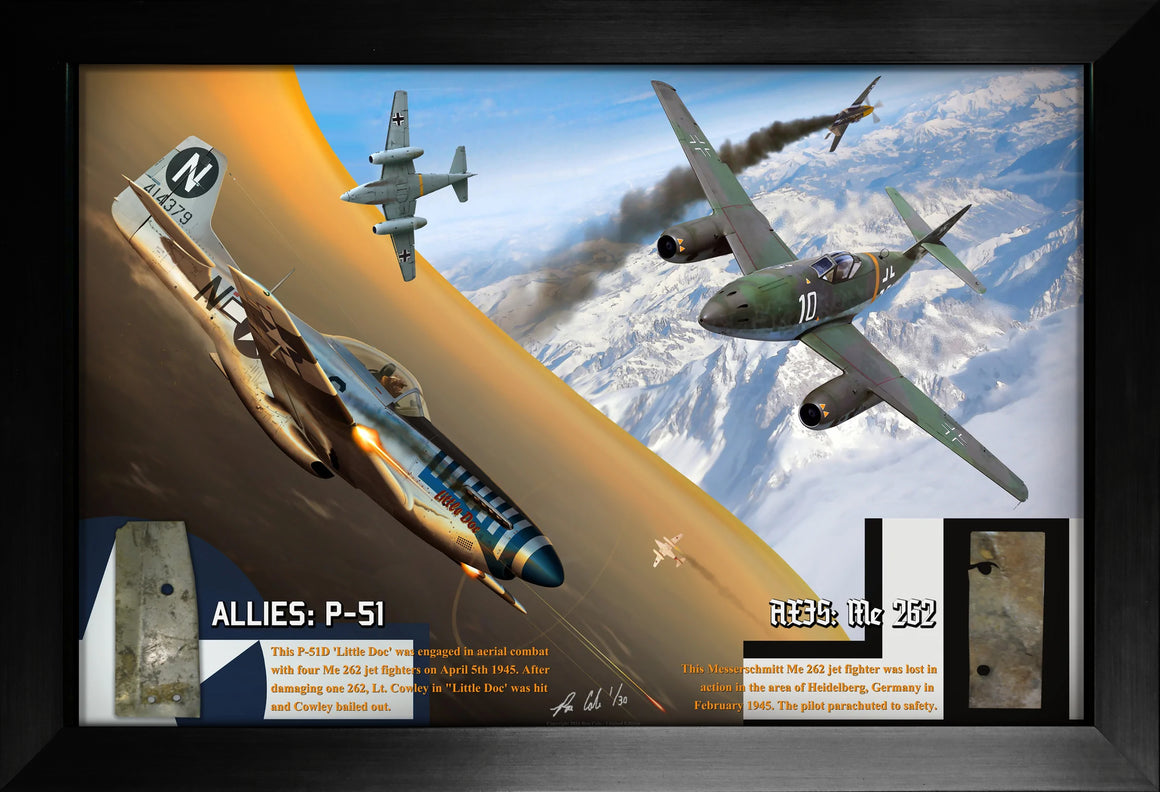
Special limited edition 'Allied & Axis' World War II aircraft relic display with authentic aluminum parts from a combat loss USAAF P-51 Mustang and a combat loss German Luftwaffe Me...