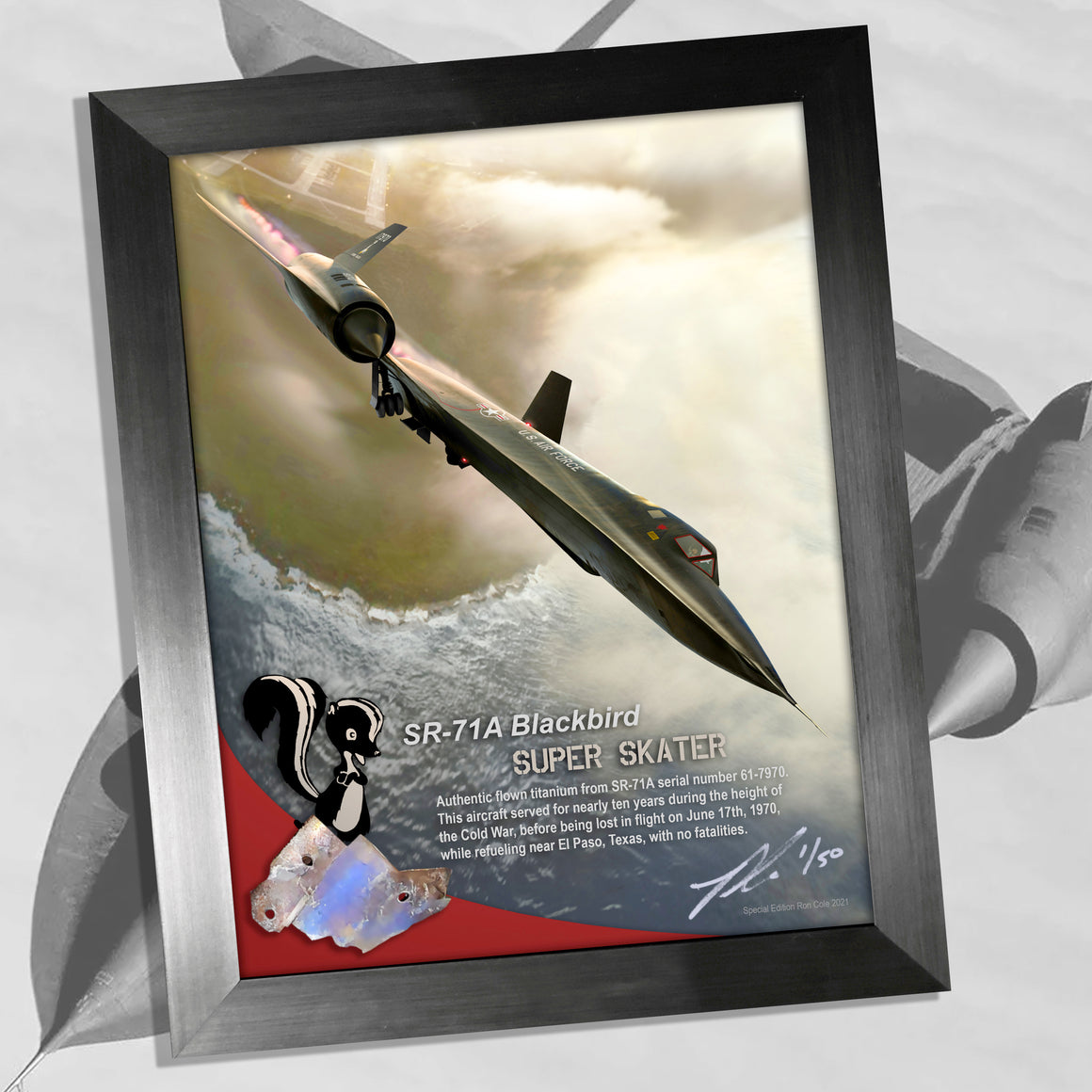
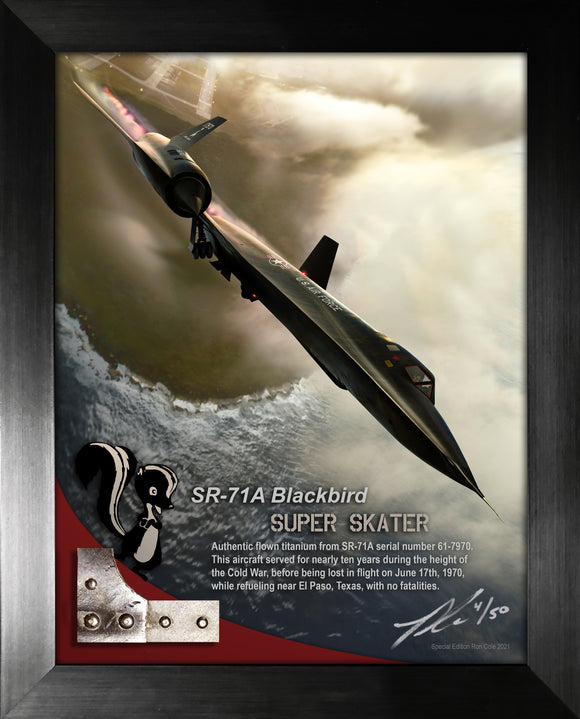
Ron Cole has combined an authentic and rare piece of camouflaged linen from the Fieseler Fi-156 Storch with his original artwork of this aircraft attempting to escape a sandstorm in North Africa. These pieces of near-perfectly preserved material are cut from adjacent the port-side underwing Balkenkreuz of this aircraft, along the wing's leading edge (see images). Each of these signed & numbered displays measure 11x17-inches (size of artwork) and are framed in a satin-finished black frame that is ready to hang.
.
This rare and well-preserved section of original linen from this aircraft was obtained in November 1942 by Col. George B. Jarrett in El Dabaa, Egypt as part of a larger Balkenkreuz from the lower/port wing. This relic has been on display in the Aberdeen Proving Grounds from 1946 to 1954, after which it was sold to collector Robert Boehme, and acquired by Ron Cole from the Boehme Estate in 2002.
.
The Fieseler Fi 156 Storch:
.
The Fieseler Fi 156 Storch was one of the most distinctive utility aircraft of the Second World War. Designed in Germany in the mid-1930s in response to a Reich Air Ministry requirement for a light aircraft capable of liaison, army cooperation, observation, and medical evacuation, it first flew in May 1936 and entered service in 1937. Its name, Storch—“stork”—came from its long, dangling undercarriage and high-wing silhouette, which gave it the appearance of a long-legged bird in flight.
.
Its reputation rested on remarkable short takeoff and landing performance. Full-span leading-edge slats, large slotted flaps, a lightly loaded wing, excellent visibility, and long-stroke landing gear allowed the aircraft to operate from rough fields, roads, clearings, and improvised strips. Contemporary summaries commonly cite takeoff runs of roughly 65 meters and landing runs of about 20 meters, while pilots noted that in a strong headwind the Storch could seem almost to hover. It was slow, lightly armed, and vulnerable, but in its intended role it was exceptionally effective.
.
The Storch is closely associated with Field Marshal Erwin Rommel, who used it in North Africa to move rapidly between headquarters and forward positions and to observe the battlefield from the air. This suited Rommel’s command style: fast, personal, forward, and highly dependent upon immediate knowledge of terrain and enemy movement. From the cockpit of a Storch, a commander could grasp the scale and direction of armored operations far more quickly than by road convoy alone. In this sense, the aircraft functioned almost as an airborne command car.
.
Limited edition, signed and numbered, display is 11x17-inches (artwork size). Limited to only 75.
Includes COA with photos of the original souvenired piece and location on the actual aircraft, attached to the reverse of each display.